Textbook Supply
Use nine selected textbook series in your own classes, or distribute them to other schools and learning centers. Each series comes with standard support.
An English listening and speaking program that helps children understand sentence patterns and grammar, write what they hear and answer questions about their own lives.
Listening Wise develops the ability to understand meaningful spoken English, learn sentence patterns and respond appropriately to situations. Who, when, where, what, how and why guide attention to sentence information, connected with dictation, sentence reconstruction and answering questions. Learning progresses from familiarity with basic patterns toward understanding more complex relationships and responding in ways that fit the learner’s own situation.
Early learning uses repeated listening to sentences children can understand, connecting spoken language with the actions and situations it communicates. Children learn sentence sounds together with meaning, then practice saying expressions that have become familiar.
Across repeated language experiences, learners notice word order and form and how these differences relate to meaning. The program’s term “listening grammar” describes learning sentence patterns and grammatical regularities through listening.
Who, when, where, what, how and why help children examine the information in a sentence: who is acting, what is happening, and the time, place, manner or reason involved.
Questions guide attention to the information a listener needs. Learners connect that information with the words and sentence patterns used to express it, practicing basic grammar through meaningful listening and speaking.
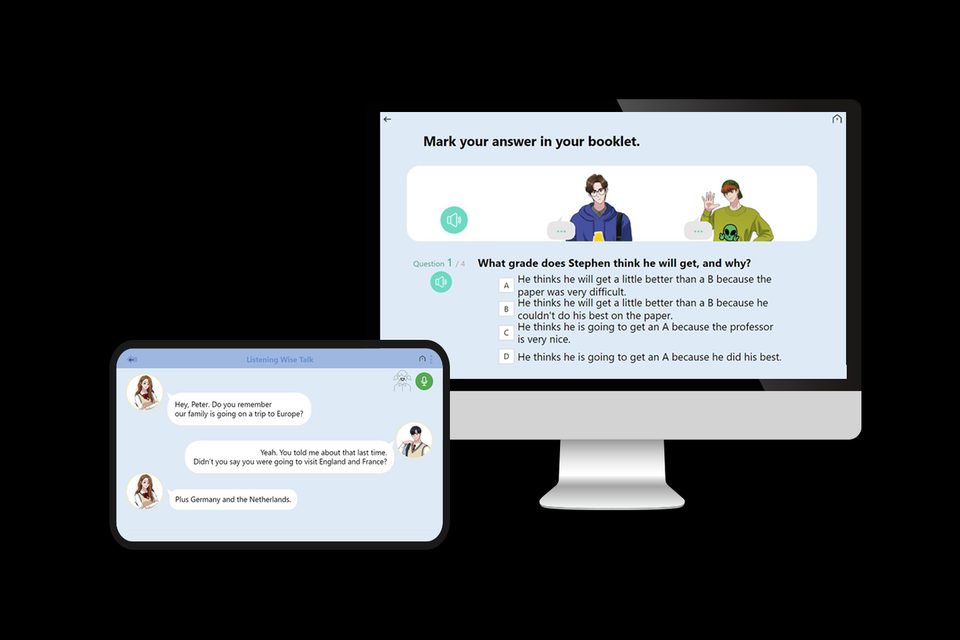
Children listen to a dialogue, identify its content, write sentences they hear and answer questions. Connecting the transcription of spoken language with understanding the conversation makes what they have heard more explicit.
They also select suitable words and arrange them to complete sentences. Reconstructing heard expressions through word forms and order provides another way to examine how sentence structure communicates meaning.
As learning progresses, expressions become more varied and meaning relationships more complex. Book 3-A, for example, includes questions about location and ways of travelling, reasons and purposes, duration and experience, and thoughts and judgments.
Children identify relevant information in a dialogue and connect word order and form with meanings such as time, reason, purpose and thought. Familiar sentence patterns provide a foundation for understanding and handling a wider range of spoken meanings.
Children repeat heard sentences aloud to develop fluency, then listen to questions and answer for their own situations. Comparing their answers with those of the dialogue’s characters shows how the same sentence pattern can communicate different content.
Teachers consider sentence repetition, understanding of the conversation and personal responses separately. Observing whether a response includes relevant information and fits the situation helps teachers adjust support for turning understood English into usable expression.
Four levels take learners from beginning English toward intermediate speaking, with two books per level and eight in total. Online listening and speaking connect with workbook reading and writing.
Teacher resources support lesson guidance and individual practice. Within the Pangram curriculum, Listening Wise complements reading and PYP with listening-based work on sentence patterns and grammatical relationships, supporting independent expression of understood content.
The eight-book collection comes with teacher resources.
These are the ways this program can be used. Tell us your goals and we will discuss the configuration, scope of use and support.
Use nine selected textbook series in your own classes, or distribute them to other schools and learning centers. Each series comes with standard support.
Choose the content and programs you need for your own education business. We agree with each partner on what can be used, how it can be used and the support provided.
We discuss program options, support, territory and contract terms for each project and partnership.
From brand franchising and the supply and distribution of textbooks and content to international business, B2C sales and learning services. Tell us about the business you have in mind and we’ll recommend the best fit.